Story
Daksha Yagna: Sati, Virabhadra and the Broken Sacrifice
Daksha holds a great sacrifice and leaves Shiva out. Sati dies in protest, Virabhadra breaks the rite, and Shiva finally restores Daksha. A retelling of Sati Khanda chapters 26-43.
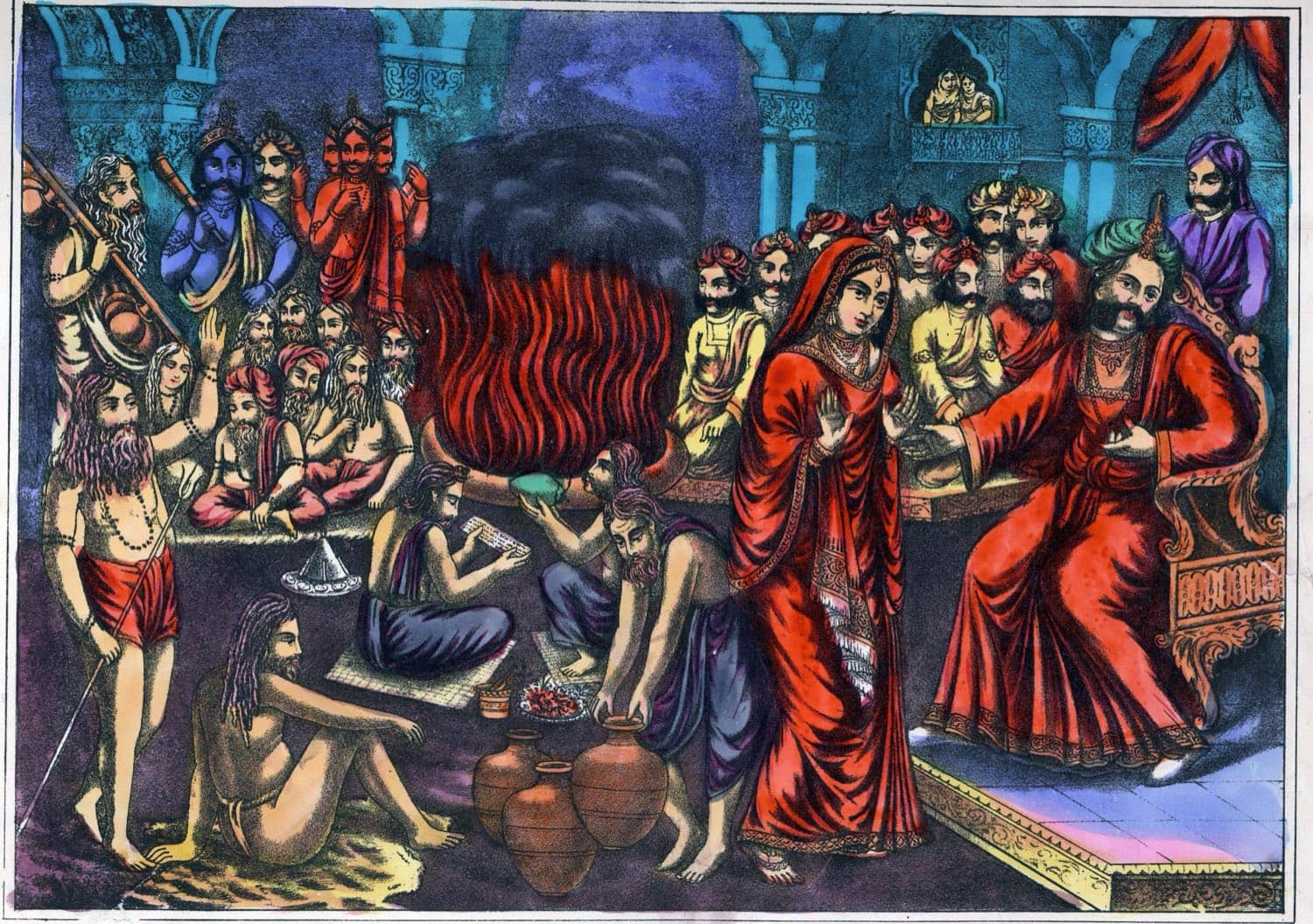
Source
Shiv Puran · Rudra Samhita · Sati Khanda · ch. 26-43
Chapter numbers follow the J.L. Shastri (Motilal Banarsidass) edition. Chapters 38-39 are a side story about the sage Dadhici and King Kshuva and are not retold here. The idea that Sati's body fell in 51 places, forming the Shakti Peethas, is later tradition. It is not part of this account.
The story
In the Shiv Puran, Brahma tells this story to the sage Narada. It sits in the Sati Khanda of the Rudra Samhita, and it begins with a quarrel.
The quarrel. At a great sacrifice at Prayaga, the gods and sages rose and bowed as Shiva arrived with Sati. Daksha, the chief of the Prajapatis, then entered. Shiva stayed seated and did not greet him. Daksha took this as an insult. He called Shiva shameless and unfit for a share of the offerings, and declared that Shiva should receive none alongside the gods. Nandin, Shiva's attendant, rebuked Daksha. Daksha then cursed Shiva's followers. Nandin in turn cursed the brahmins who had sided against Shiva, and Daksha too, saying he would be goat-faced. Shiva laughed and told Nandin that he had cursed the brahmins in vain, wrongly thinking Shiva had been cursed. Shiva had not been cursed, he said, for he is the sacrifice itself and all. Shiva then left, and Daksha went away still angry (chapter 26).
The sacrifice without Shiva. Daksha later began a grand sacrifice at Kanakhala. Sages, gods, Vishnu, and Brahma all came, and Daksha set Bhrigu and other sages to conduct it. He left out Shiva and Sati on purpose, saying Shiva wore skulls and had no standing. The sage Dadhici objected that the rite was incomplete without Shiva, from whom all good results come. Daksha brushed him aside, and Dadhici and other devotees of Shiva left (chapter 27).
Sati decides to go. On Mount Gandhamadana, Sati saw the moon travelling with Rohini toward her father's sacrifice. Her attendant Vijaya found out where it was going. Sati was puzzled that no invitation had reached her. She asked Shiva to go with her. He refused: Daksha was his adversary, and going uninvited brings only humiliation. Sati pressed on, wanting to see her father's conduct for herself. Shiva saw her resolve and let her go. He gave her a decorated bull and sixty thousand attendants (chapter 28).
At her father's house. Her mother Asikni and her sisters welcomed Sati. Daksha ignored her. Sati saw that Shiva had no share in the offerings. She spoke out against a sacrifice made without Shiva, who is himself sacrifice, and she reminded Vishnu, Brahma, and Indra of times Shiva had shown his power over them. Daksha answered with more abuse. Sati asked herself how she could go back to Shiva after hearing him insulted. She told her father she would give up the body that was born of him. She declared that she would enter fire, and she warned the gathering that Shiva would punish them (chapter 29).
Sati leaves her body. She sat on the north side of the sacrificial ground, purified herself, and entered a yogic meditation. She drew her life breath upward, and her body burned away in the fire of yoga. People cried out in horror. Of Shiva's sixty thousand attendants, about twenty thousand died by their own weapons in grief. The rest tried to attack Daksha, but Bhrigu called up the Ribhus through the fire rite, and Shiva's attendants were driven back. The gods stood silent in fear (chapter 30).
A voice from the sky. A heavenly voice rebuked Daksha. He had ignored Dadhici and failed to honour his own daughter. The voice described Sati as the primal power and Shiva as the lord worthy of worship. It said the sacrifice would be destroyed, and it told everyone present to leave (chapter 31).
Virabhadra is born. The defeated attendants fled to Shiva. He called Narada, who told him everything. Shiva was furious. He pulled out a lock of his matted hair and struck it against a mountain. It split in two. From one half came Virabhadra, huge, with two thousand arms. From the other came Mahakali with her troops. Virabhadra bowed and offered to do whatever Shiva asked. Shiva sent him to destroy the sacrifice and everyone who stayed there, whoever they might be (chapter 32).
The march and the omens. Virabhadra set out with a vast host of attendants. At the sacrifice, Daksha's left eye, arm, and thigh twitched. The ground shook, stars showed at noon, and vultures circled overhead. A voice told Daksha that great suffering from Shiva was certain. He ran to Vishnu (chapters 33 and 34).
Vishnu cannot help. Vishnu told Daksha that insulting Shiva makes every effort fail. He admitted that he had done wrong by backing Daksha, and said that his own discus would not harm Virabhadra, because the discus is devoted to Shiva (chapter 35).
The battle. Indra and the other gods fought and at first Bhrigu's spells helped them. Virabhadra struck back and they fled. Brihaspati told Indra that nothing can stop what Shiva wills. Vishnu faced Virabhadra, said he served Shiva and had only honoured Daksha's request, and the two agreed to fight (chapter 36). Shiva's power held Vishnu's discus still. The gods were overwhelmed. When the sacrifice took the form of a deer and fled, Virabhadra beheaded it. Others were punished: Pushan lost his teeth, Bhaga his eyes, and Sarasvati and Aditi the tips of their noses. Daksha hid behind the altar, but was dragged out and beheaded, and his head was thrown into the fire. Virabhadra returned to Kailasa, and Shiva approved (chapter 37).
Restoration. Brahma was distressed for his son. He and the gods went to Vishnu, who said the gods had offended Shiva and should seek his forgiveness. Vishnu led them to Kailasa, where Shiva sat under a fig tree (chapter 40). They praised him and asked him to forgive them, to give Daksha life, and to heal those who were hurt (chapter 41). Shiva said the destruction was not done by him, and forgave them. He told them to fit the head of a goat onto Daksha's body. Daksha woke beside Shiva, free of hatred, and praised him. The text says Pushan stayed broken-toothed and Bhrigu came away with a goat's beard (chapter 42).
Shiva then spoke to Daksha about devotion and knowledge. He said that rites alone do not free a person, and that Brahma, Vishnu, and he are one principle. Daksha finished the sacrifice and gave Shiva his share, and the gods went home. The chapter closes by saying that Sati would be born again as Parvati (chapter 43).
What it means
The text states its own point. The voice in chapter 31 says the sacrifice fails because Shiva and Sati were not honoured. Vishnu tells Daksha in chapter 35 that insulting Shiva makes every action futile. In chapter 43, Shiva himself says rituals without knowledge and devotion do not lead to liberation.
The account also points ahead: chapter 43 says Sati will be reborn as Parvati.
Some sources tell the story differently. A later and widely told tradition adds that Shiva carried Sati's body and that its parts fell in many places, becoming the Shakti Peethas. The Sati Khanda chapters retold here do not tell this.
Lessons
- Pride that shuts out the divine, as Daksha's did, is what the text blames for the ruin.
- Even Vishnu and Brahma are shown unable to save a rite built on that insult.
- The text ends in mercy. Shiva restores Daksha, Daksha's hatred is gone, and the sacrifice is finished with Shiva given his due.
