Story
Samudra Manthan and Neelakantha: What the Shiv Puran Says
Gods and demons churn the ocean of milk for nectar, and a deadly poison rises first. This page follows the Shiv Puran's own accounts of how Shiva held the poison in his throat, and says where other texts differ.
Source
Shiv Puran · Shatarudra Samhita · ch. 16 · vv. 2-39
Shiva drinks the poison and the churning resumes (vv. 2-16), then the Yaksha and blade-of-grass episode (vv. 17-39). J.L. Shastri numbering, Motilal Banarsidass.Shiv Puran · Shatarudra Samhita · ch. 22 · vv. 1-55
The longer churning narrative; Shiva keeps the Kalakuta poison in his neck (v. 26), and the chapter leads to the bull incarnation (v. 1).Shiv Puran · Shatarudra Samhita · ch. 10 · vv. 32-36
The gods recall the poison and the name Neelakantha when they ask Shiva for help against Nrisimha.
Show all 7 sources
Shiv Puran · Rudra Samhita · Yuddha Khanda · ch. 15 · vv. 12-28
The churning is mentioned only as background to the Jalandhara story. The poison is not told here.Bhagavata Purana · Canto 8, chapter 7, verses 18-46
The best-known telling of Shiva drinking Halahala, including Bhavani's consent.Mahabharata, Adi Parva (Astika Parva) · Section 18 (Ganguli's numbering) · K.M. Ganguli translation, public domain
Names the poison Kalakuta; Brahma asks Shiva to swallow it.Vishnu Purana · Book 1, chapter 9 · H.H. Wilson translation, 1840, public domain
Mentions the poison but gives it to the Nagas, not to Shiva.
The story
The churning of the ocean of milk is told in many Puranas, and the versions do not match in every detail. This page keeps track of which text says what. The Shiv Puran does tell the episode, but it is not a single long narrative in one chapter. It appears in the Shatarudra Samhita, where Nandishvara, Shiva's attendant, tells it to a sage as part of his account of Shiva's incarnations. References below follow the J.L. Shastri (Motilal Banarsidass) numbering, which other editions may not share.
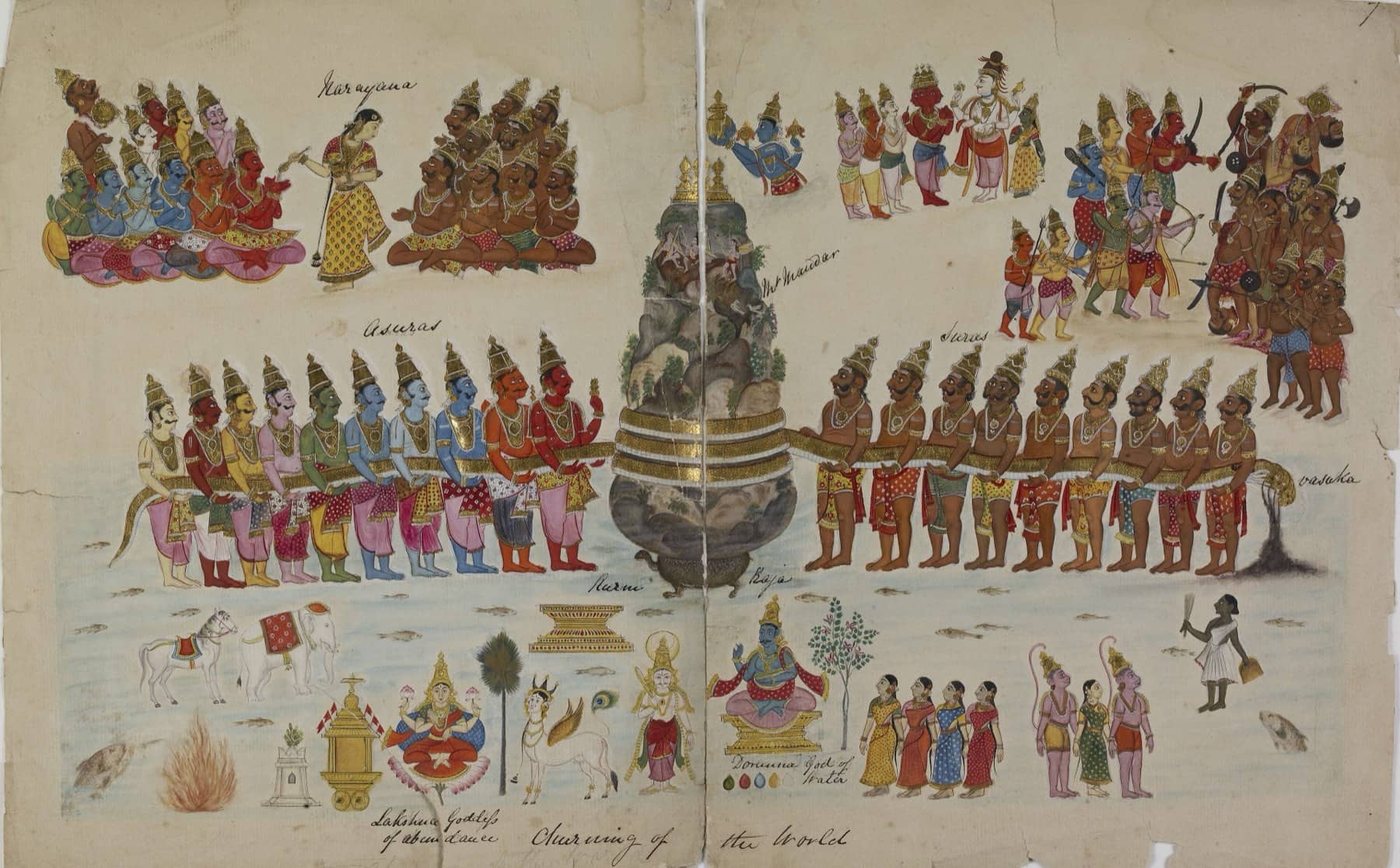
The first account: Shatarudra Samhita, chapter 16. Here the gods and the Daityas, each with their own aims, begin to churn the ocean of milk to win the nectar of immortality. The poison comes out first, as fierce as the fire that ends a cosmic age. Gods and demons are terrified and run to Shiva for protection, and Vishnu is among those who bow to him. Shiva, who favours those who take refuge in him, drinks the terrible poison and keeps it in his throat. It marks him, and he becomes blue-necked, Neelakantha (also spelled Nilakantha, "the blue-throated"). Freed from the burning, the gods and Asuras start churning again. Many gems rise, but both sides prize the nectar most. The gods drink it, through Vishnu's favour, and a great battle follows.
The same chapter adds a detail you will not find in most retellings. When Rahu eclipses the moon, the moon flees in fear to Shiva's home and begs for protection. Shiva keeps the moon on his head because it came to him for refuge.
The second account: Shatarudra Samhita, chapter 22. This one is fuller, and it tells the order of events differently. The gods and Asuras, fearing ageing and dying, make an alliance to take treasures from the ocean. They are unsure what to churn with, and a voice from the sky, sent by Shiva's wish, tells them to use Mandara as the churning rod and Vasuki as the rope. They go to Mandara and, after honouring Shiva and getting his consent, try to lift it. The mountain slips from their arms, grows suddenly heavy, and falls on them. They recover, praise Shiva as lord of all, and at his wish manage to bring it to the ocean's northern shore and set it in the water.
The churning then brings up, in the text's list, Lakshmi (here called the daughter of Bhrigu), Dhanvantari, the moon, the Parijata tree, the horse Uchchaihshravas, the elephant Airavata, wine, Vishnu's bow, the conch, the cow Kamadhenu, the Kaustubha jewel, and the nectar. The nectar is listed here among the treasures. In this chapter the Kalakuta poison appears only when they churn again, as fierce as the fire that ends the yugas. The gods and Asuras are frightened. For the gods' protection, Shiva willingly keeps the Kalakuta in his neck, and he also holds the moon on his forehead. The verse says nothing about Parvati, and does not use the word "drink". The nectar of immortality then comes out, after the poison (v. 23). Then comes a fight over it, and Vishnu takes the female form of Mohini, to deceive the Asuras and give the nectar to the gods. The chapter then moves on to a different episode, Shiva's incarnation as a bull.
Where the two Shiv Puran accounts differ. In chapter 16, the poison comes first, before anything else, and Shiva drinks it in front of the gods before churning resumes. In chapter 22, the list of treasures comes first and the Kalakuta appears only when the ocean is churned again. We have kept both accounts and not merged them. The text itself does not explain the difference.
Other mentions. In Shatarudra Samhita chapter 10, the gods pray to Shiva against the fury of Nrisimha. They remind him that at the churning, once the gems had been shared out, he took the poison, and that if he had not, everything would have burned to ashes. This is where the Shiv Puran has the gods explicitly give that as the reason for the name Neelakantha. In the Rudra Samhita, Yuddha Khanda, chapter 15, the churning is only background: the demon Jalandhara, called the ocean's son, hears of it and rages that his father was churned and robbed of jewels. No poison episode appears there.
What it means
The Shiv Puran's own framing is quite specific, and it is not mainly about sacrifice. In both Shatarudra chapters the churning leads into a lesson about pride. In chapter 16, the gods win with Vishnu's help and grow proud, and Shiva appears as a Yaksha and sets a blade of grass in front of them. Their weapons cannot cut it. A voice then tells them who he is, and they praise him. Chapter 22 describes Vishnu, after the victory, becoming infatuated and fathering sons who trouble the worlds, and it leads into Shiva's bull incarnation, which the chapter introduces as destroying Vishnu's arrogance. So the Shiv Puran uses the churning to show that Shiva is the one gods turn to in danger, and the one who corrects them afterwards.
Other texts give a different emphasis. In the Bhagavata Purana (8.7), Shiva himself explains why he will do it. He tells Bhavani that it is the duty of those who can protect to protect suffering beings, and he drinks the poison with her consent. Scorpions, cobras, poisonous plants and other biting creatures are said to have taken up the few drops that fell from his hand. The Bhagavata says the dark line on his neck came to be seen as an ornament. The popular image of Parvati pressing his throat to stop the poison descending is not in any passage checked for this page, so it is not presented here as scripture.
The Mahabharata (Adi Parva, section 18, in Ganguli's translation) tells the churning as part of the Astika Parva. There, Brahma asks Shiva, who swallows the Kalakuta for the safety of creation and is called Neelakantha ever after. The Vishnu Purana (Book 1, chapter 9, Wilson's translation) has a quite different emphasis. It begins with Indra's loss of fortune after Durvasas's curse and mentions the poison, but gives it to the Nagas. In that telling, Shiva takes the moon.
Lessons
These come from what the texts themselves say, not from added morals.
- Refuge: In the Shiv Puran, when every other power is frightened, the gods go to Shiva, and in chapter 10 they later cite this event as proof that he saves those in distress.
- Pride: In chapter 16 the gods grow proud after their victory and Shiva humbles them as a Yaksha. In chapter 22 it is Vishnu who is led astray after the victory, and the bull incarnation ends it.
- Care when you read: The same episode has different details in different Puranas. When someone says "the Shiv Puran says", it helps to ask which chapter.
For more stories and the texts they come from, see all stories.
