What the verse is
The Maha Mrityunjaya Mantra is one verse of the Rig Veda, number 12 of hymn 59 in the seventh book (7.59.12). Mrityunjaya means "conqueror of death", and is a name of Shiva. Neither that name nor the word "maha" (great) appears in the Rig Veda verse itself. The title comes from later use: the Shiv Puran, in the Sati Khanda of the Rudra Samhita (chapter 38, verse 21), calls it the Mahamrityunjaya mantra.
The verse is two lines of Sanskrit in the anushtubh metre. The edition read for this page, with Sayana's commentary, begins the verse at "tryambakam" with no opening Om. Many modern printed forms, such as the one on Shlokam.org, put Om in front. The verse data above follows the Rig Veda text, without the Om.
Word by word
- tryambakam: the accusative form of Tryambaka. The verse gives no gloss. Sayana's commentary takes it as the "father" of the three, Brahma, Vishnu and Rudra, while a reading recorded in Griffith's footnote (quoting Wilson) calls it "Rudra with three eyes". The Shiv Puran, where Shukra explains the words (Sati Khanda 38.22), reads the "three" in several ways: Shiva as the three-eyed lord, as master of the three worlds, as father of the three spheres, and as ruler of the three gunas (qualities of nature).
- yajāmahe: "we worship". It is a first person plural verb, which Sayana glosses with the Sanskrit for "we honour in worship".
- sugandhim: "fragrant", literally "well-scented". Sayana, as quoted by Griffith, takes it to mean that the lord's fame is fragrant, spreading like perfume. Shukra's explanation (38.23-25) is that Shiva is the essence of everything, as scent is the essence of a flower.
- puṣṭivardhanam: "increaser of nourishment" or "of prosperity". Sayana reads it as the one who makes the worshipper flourish. Shukra's explanation (38.26-27) is that Shiva is called the nourisher because every principle from Prakriti down to the senses, and Vishnu and Brahma, the sages and the gods, receive their nourishment from him.
- urvārukam iva: "like a cucumber". Sayana takes urvaruka as the cucumber fruit. Griffith's footnote, quoting Wilson, records another reading, the jujube fruit, which drops from its stalk of its own accord when ripe.
- bandhanāt: "from the stalk", or, in the wider sense, "from the bond". The word carries both meanings, and the verse plays on them: the fruit leaves its stalk, and the speaker asks to leave the bond of death. In the sandhi (joining) of the verse it appears as "bandhanān".
- mṛtyoḥ mukṣīya: "may I be freed from death". Note the shift to the singular. The worship is in the plural ("we"), but the request is in the first person singular ("may I be freed"), in the optative mood. A prayer for the group becomes a personal prayer in the second half.
- mā amṛtāt: "not from the immortal" or "not from immortality". The two words join as "māmṛtāt". Sayana divides the words differently, as "ā amṛtāt" (see below).
Where the verse comes from
Hymn 7.59 is credited to the sage Vasishtha. Its first eleven verses are addressed to the Maruts, the storm gods who are called sons of Rudra in the Rig Veda. Verse 12 is a separate verse addressed to Rudra. In his commentary, Sayana quotes an index to the hymn that names the last verse as Raudri (belonging to Rudra) and as the "death-releasing" verse (mrityuvimochani rik).
Sayana also records two variations in how the last line has been understood. In his own gloss he divides the words as "ā amṛtāt" rather than "mā amṛtāt", and reads it as "release me up to amṛta", meaning until the liberation of union with the lord (sāyujya), so the speaker asks to be released from death up to that state. Another reading, quoted in his commentary on the Taittiriya text, takes it to mean that the speaker asks not to be released from long life or from heaven. The same commentary cites the verse in the Taittiriya Samhita (1.8.6.2) and a Taittiriya Brahmana passage (1.6.10.5) that explains the last line. Griffith's footnote adds that the verse occurs in the Yajur Veda as well. The Rig Veda verse itself gives no explanation, so these are readings by later commentators, not statements in the verse.
The mantra in the Shiv Puran
The Shiv Puran tells how the mantra was taught and used in the Rudra Samhita. The longest account is in the Sati Khanda, chapter 38 (J.L. Shastri numbering).
Why the chapter is told
The chapter follows the Daksha Yagna narration (see Daksha Yagna). Narada asks Brahma why Vishnu went to Daksha's sacrifice without Shiva. Brahma answers (verse 6) that Vishnu had lost his knowledge through Dadhici's curse, and so went with the gods to help a king named Kshuva.
Kshuva and Dadhici
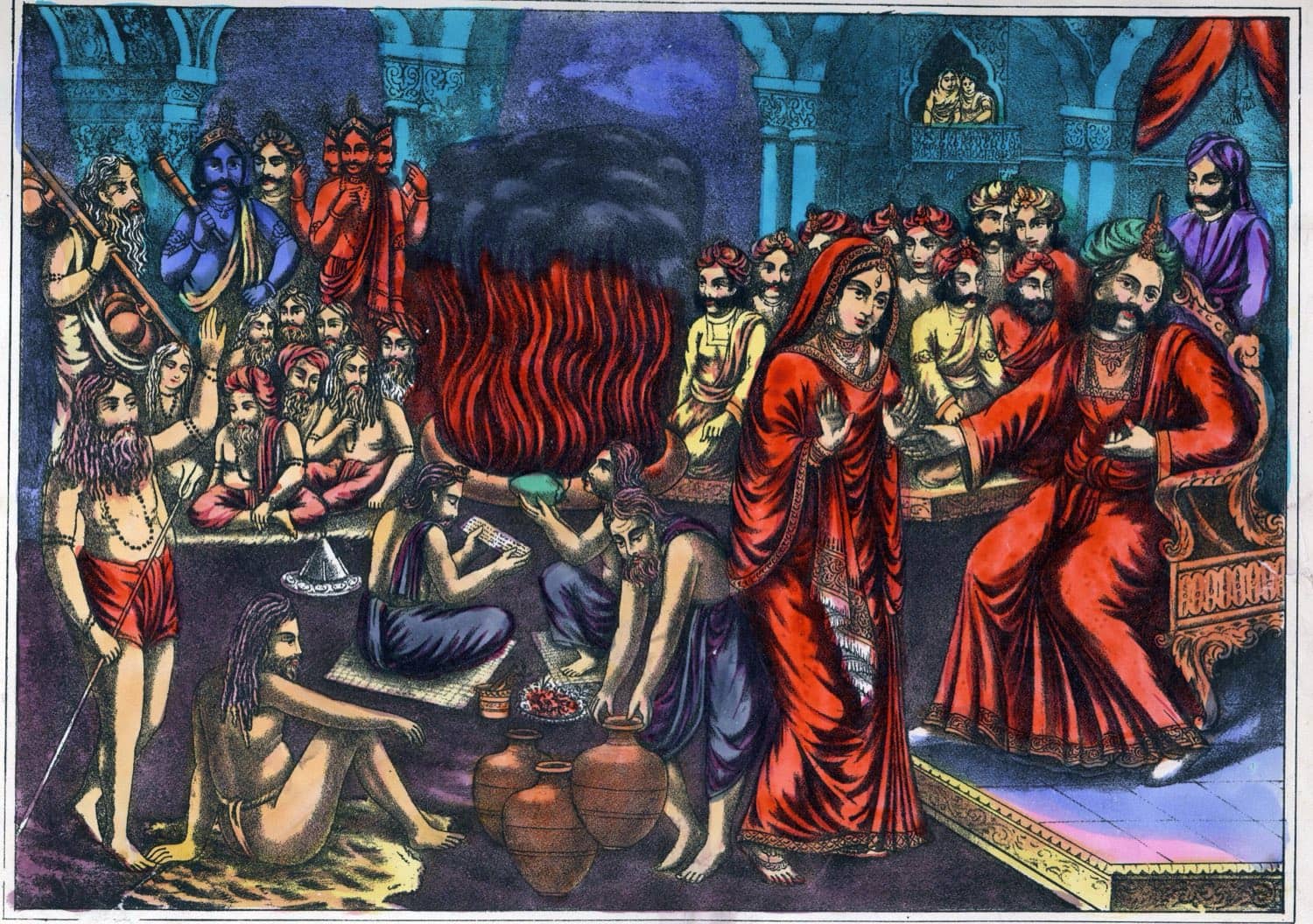
Kshuva was a king and a friend of the sage Dadhici, a devotee of Shiva. A dispute arose between them (verses 8-9). Dadhici said that only a brahmin is truly noble among the three higher varnas. Kshuva, proud of his wealth, answered that a king carries within him a share of each of the eight world-guardians, that the Vedas call a king the embodiment of all the gods, and that he should therefore be honoured (verses 10-14). Dadhici struck Kshuva on the head with his left fist, and Kshuva struck back with his thunderbolt (verses 16-17).
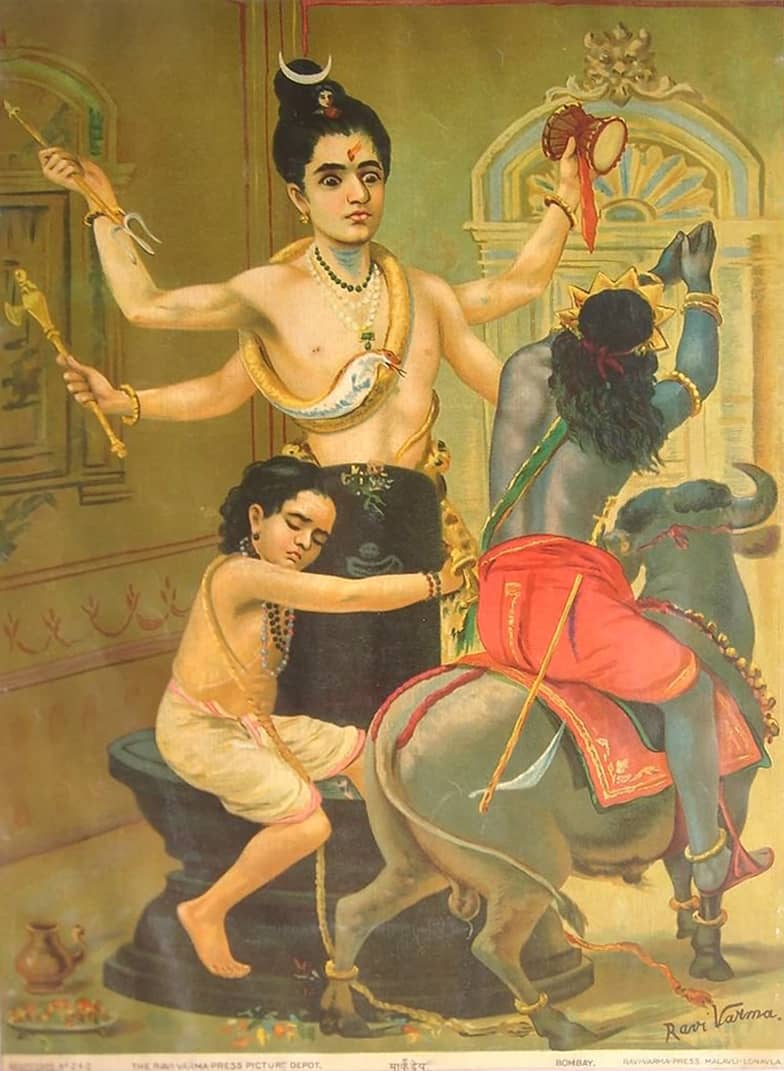
Struck by the thunderbolt, Dadhici remembered Shukra, one of his ancestors. Shukra came, joined the broken limbs back together (verses 18-19), and, as the text describes him, a leading devotee of Shiva and the initiator of the Mrityunjaya lore, offered to teach Dadhici the Vedic mantra Mahamrityunjaya (verses 20-21).
What Shukra teaches
Shukra's teaching covers three things in the text.
- An explanation of the words. He unpacks "three-eyed", "fragrance" and "nourisher" as described above (verses 22-27).
- A way of worship. He tells Dadhici to worship Shiva through rites, penance, study of the Vedas, yoga, meditation and truthfulness, and says this frees one from the noose of Yama, because the lord is the source of bondage and also of release (verses 28-29). He calls this the Mritasanjivani mantra ("the reviver of the dead"), the best of all in his opinion. It is to be repeated regularly with devotion to Shiva. The Sanskrit of verse 31 says that after japa (repetition) and homa (fire offering), water is to be consecrated with the mantra and drunk day and night (Shastri's translation reads this line as a fast with water allowed). Shukra says that if the meditation is done in Shiva's presence, death holds no fear anywhere (verses 30-31). Nyasa and other ritual acts are to be performed, Shiva is to be worshipped properly, and the meditation is to come before the repetition, which continues until the aim is reached through Shiva's power (verses 32-33).
- A meditation image. The lord is pictured with Parvati, three-eyed, pouring water over his own head from two pots held in two hands, with two more hands holding pots on his lap, a rudraksha garland and a deer in the remaining two, and his body cooled and wet with nectar flowing from the moon on his head (verse 34).
What Dadhici does
Dadhici went to the forest and kept up the mantra over a long period by the rules, remembering Shiva, until Shiva appeared (verses 36-39). Dadhici asked for three boons: bones as hard as adamant, freedom from being killed, and freedom from distress. Shiva granted them (verses 43-44).
Dadhici then kicked Kshuva on the head, and Kshuva struck him on the chest with his thunderbolt, which could not harm him, through the power of Shiva, and Kshuva was astonished (verses 46-49). Kshuva, defeated, went to the forest and propitiated Vishnu (verses 50-53). He told Vishnu that Dadhici, proud of the favour won from Mrityunjaya, had kicked him (verses 54-57). Vishnu thought of Shiva's unrivalled power (verse 58). He told Kshuva that brahmins need fear nothing, especially devotees of Shiva, and that Dadhici would curse him if provoked. He also foresaw his own destruction at Daksha's sacrifice through a curse, though he would rise again, and promised that he would strive for Kshuva's victory over Dadhici (verses 59-62). The Daksha Yagna page does not retell this side story, and the rest of the quarrel lies beyond chapter 38.
How Shukra got the lore
A second account is in the Yuddha Khanda of the Rudra Samhita, chapter 50. Sanatkumara tells Vyasa how the sage Bhargava (Shukra) won from Shiva, here called Mrityunjaya, the lore that keeps death away (verse 1). Shukra went to Varanasi, set up a linga, dug a well in front of it, bathed the linga many times with the five nectars, offered sandal paste, flowers and leaves, sang praises and recited the thousand names of Shiva, and worshipped for five thousand years (verses 2-13). When Shiva did not appear, Shukra took up still harder vows, drinking smoke for a thousand years (verses 14-16).
Shiva then came out of the linga, pleased, and offered a boon (verses 17-20). Shukra praised him as the eight-formed lord in eight verses (verses 23-33). Shiva called him a faithful devotee and gave him, among other boons, the lore he calls Mritasanjivani. Chapter 50 does not quote the words of this lore. It is connected to the Tryambakam verse because chapter 38 uses the same names for the mantra Shukra teaches Dadhici (verses 21 and 30). Shiva says that he formulated it himself through penance, and that anyone over whom Shukra repeats it will return to life (verses 36-43). Sanatkumara ends by saying this is how the Mrityunjaya lore was acquired by Shukra (verse 53). Earlier, in chapter 49 (verse 42), Sanatkumara had closed the Andhaka story by saying that the Mrityunjaya mantra, which bestows immortality, had also been mentioned and should be recited with effort. That verse does not quote the words either, so its link to the Tryambakam verse rests on the shared name.
How the mantra is recited
The Shiv Puran passage above is the main scriptural instruction on method: devotion to Shiva, repetition, a fire offering, drinking water consecrated with the mantra, ritual steps and meditation (Sati Khanda 38.30-33). Beyond the Shiv Puran, two other sources describe use of the verse, and each is a tradition rather than something the Rig Veda verse itself says.
- A ritual from the Rig Veda commentary. Sayana, commenting on the verse, quotes a passage ascribed to Shaunaka (cited there as "Rgvi. 2.314-15"). The same passage is Rigvidhana 2.27.142-143 in M.S. Bhat's edition, so Sayana's numbers come from a different edition. It describes fasting for three nights with restraint, cooking a pot of milk-rice, and offering a hundred oblations with this verse, addressing Mahadeva as Tryambaka. The passage says that one who keeps this up for a hundred "parvans" lives a hundred years in happiness. The quotation does not say what a parvan is here.
- Present-day practice. Modern guides, such as Shlokam.org, describe a traditional recommendation of 108 repetitions, with smaller numbers such as 3, 11, 21 or 31 also named, and say that family and friends chant it for a sick or dying person. This is a description of current practice by that website. Neither the Rig Veda nor the Shiv Puran passages read for this page prescribe the number 108, and the page does not promise any outcome from chanting.
A note on the translation
The verse data above is a faithful reading of the Sanskrit in the Rig Veda text. English renderings differ mainly in how they take "tryambaka" (three-eyed, or father of the three, Brahma, Vishnu and Rudra), "sugandhi" (fragrant, or of fragrant fame), "urvaruka" (cucumber, or jujube fruit), and "amṛta" (immortality, long life, or union with the lord). The page follows the plainest sense of each word and records the other readings above, with their sources.